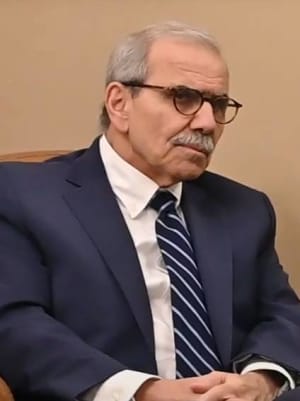
Head of State Lebanese

Nawaf Salam

Nawaf Salam is the Prime Minister of Lebanon. Known as a former international jurist and diplomat who advocates Lebanese state sovereignty and restraint of non-state armed actors. Recently, Salam has pursued Israeli withdrawal from southern Lebanon, asserted exclusive state authority over war and peace decisions, and engaged in active regional diplomacy. Last updated 3 days ago
Nawaf Salam

Latest coverage

Leaders

Residents of southern Lebanon have paid a heavy price in lives, livelihoods and homes, Lebanese PM Nawaf Salam declared after a morning meeting with President Joseph Aoun. They have the right to live in security, free of war, displacement a...

Residents of southern Lebanon have paid a heavy price in lives, livelihoods and homes, Lebanese PM Nawaf Salam declared after a morning meeting with President Joseph Aoun. They have the right to live in security, free of war, displacement and destruction.

Salam warned of "the consequences of dragging Lebanon into a new absurd adventure in the service of foreign interests and the consequences of bringing Lebanon into conflicts whose consequences it cannot bear."

Defending Lebanon requires putting the national interest first, he added. The decision on war and peace must stay with the state and its constitutional institutions: the government and the presidency.

Salam: "We will not accept the fact that a fate they did not choose will be imposed on the Lebanese or that Lebanon will once again become an arena for other people's conflicts."

Kann news.

Leaders

Secretary of State Marco Rubio said the deployment of the Lebanese army in southern Lebanon is insufficient without the disarmament of Hezbollah, calling disarmament a core clause of the framework agreement that has yet to be carried out. In remarks to Lebanese Prime Minister Nawaf Salam, Rubio said U.S. support for Lebanon is conditioned on distance from the "harmful influence" of Hezbollah and Iran.

Global

Washington told Lebanese PM Nawaf Salam in New York that Israel will keep operating and stay in the southern Lebanon security zone until Beirut seriously disarms Hezbollah, per Qatari outlet Al-Araby Al-Jadeed.

U.S. officials called Lebanon's steps insufficient and warned the situation could worsen.

Leaders

Lebanese PM Nawaf Salam at the UN:

We want the war to end, the ceasefire stabilized, an Israeli withdrawal to the international border, the release of all prisoners, the return of the displaced and reconstruction. Lebanon entered negotiations with Israel under U.S. and Trump leadership to end the war and restore full Lebanese sovereignty.

The success of any agreement is not in the declaration but in fulfilling the commitments.

Global

Lebanese Prime Minister Nawaf Salam is expected to meet Iranian President Masoud Pezeshkian on the sidelines of the UN General Assembly in New York, according to the Lebanese newspaper Al-Modon. A meeting at that level between Lebanese and Iranian officials has not happened in a long time.

-Kann News.

Global

Lebanese President Joseph Aoun, with PM Nawaf Salam, is pushing to sign an EU military cooperation deal to bring in a European force replacing UNIFIL when its mandate ends this year, per Al-Akhbar.

Aoun is treating it as needing no cabinet approval or parliamentary law, backed by the U.S., which favors limiting European participation to Italy. His Rome visit will raise the file with PM Giorgia Meloni.

Leaders

Lebanese PM Nawaf Salam, on X, responding to the IDF strikes across southern Lebanon:

"The Israeli escalation this morning toward Nabatieh, the villages of Ansar, Deir al-Zahrani and nearby villages is extremely dangerous and undermines ef...

Lebanese PM Nawaf Salam, on X, responding to the IDF strikes across southern Lebanon:

"The Israeli escalation this morning toward Nabatieh, the villages of Ansar, Deir al-Zahrani and nearby villages is extremely dangerous and undermines efforts to stabilize southern Lebanon. The seven killed in Ansar were not 'military infrastructure,' and the women and children killed there were not military targets. Dealing with military infrastructure on Lebanese soil is the sole responsibility of the Lebanese state, through the Lebanese army. Israel must halt the escalation."

Leaders

Lebanese PM Nawaf Salam has hit back at Hezbollah chief Naim Kassem, who accused the government of aiding Israel instead of defending sovereignty.

Salam: the greatest help to Israel came from those who pulled Lebanon into "absurd" aid wars...

Lebanese PM Nawaf Salam has hit back at Hezbollah chief Naim Kassem, who accused the government of aiding Israel instead of defending sovereignty.

Salam: the greatest help to Israel came from those who pulled Lebanon into "absurd" aid wars, giving Israel the reasons to strike its cities, kill its children and displace hundreds of thousands.

He added that whoever seizes the state's war decisions and ties Lebanon to external agendas "has no right to hand out certificates of patriotism, and certainly not to speak of sovereignty."

Leaders

Lebanese Parliament Speaker Nabih Berri:

"I am waiting for the results of the Washington meetings to see to what extent they adhere to their promises for the practical translation of Israel's withdrawal from southern Lebanon."

Berri said...

Lebanese Parliament Speaker Nabih Berri:

"I am waiting for the results of the Washington meetings to see to what extent they adhere to their promises for the practical translation of Israel's withdrawal from southern Lebanon."

Berri said there is no indication from Syria or Lebanon of any desire to create tension or military intervention, and that relative calm prevails.

On Nawaf Salam's visit to western Zawtar, Berri called it a symbolic act, adding that he advised Salam to go early and coordinate with the army because Israel continues its shelling.

Global

With Trump's backing and after his gains in Syria, Erdogan is moving to insert Turkey into the Lebanese arena. His intended target for political influence, Sunni politicians and MPs in Beirut, is expressing lack of enthusiasm and even dissa...

With Trump's backing and after his gains in Syria, Erdogan is moving to insert Turkey into the Lebanese arena. His intended target for political influence, Sunni politicians and MPs in Beirut, is expressing lack of enthusiasm and even dissatisfaction in closed conversations, a Lebanese source told Kann.

The opposition ties to three factors: bad memories of the Ottoman era in Lebanon, Erdogan's Islamist ideology, and a preference for the long-standing Saudi patronage of Sunnis and other communities over Turkish patronage.

Unlike Saudi Arabia, Turkey holds no influence over Lebanon's Sunni lawmakers, but they are closely tracking Erdogan's moves, especially his influence over neighboring Syria. Days ago, Erdogan hosted Sunni PM Nawaf Salam in Ankara with full honors.

"The Lebanese leadership cannot publicly oppose the Turkish involvement, only deal with it pragmatically, certainly when the U.S. president supports Erdogan," the source said.

@kaisos1987

Global

Lebanese Prime Minister Nawaf Salam is expected in Istanbul tomorrow for talks with President Erdogan.

The visit comes after Erdogan warned that Israel’s operations in Lebanon also threaten Turkey.

Hezbollah linked Al Akhbar claims the U.S. now views Turkey as the country with the broadest influence in Lebanon, even surpassing Saudi Arabia. @kaisos1987

Leaders

Reporter: If the United States were to pressure the Lebanese government to accept Syrian involvement in disarming Hezbollah, would you agree to that?

Lebanese PM Nawaf Salam: No, no, neither he nor I will answer this question.

I believe President Ahmed al-Sharaa has already answered this question, and more.

On behalf of Minister Asaad al-Shaibani, there is nothing to add to what President Ahmed al-Sharaa said, and I have nothing to add either.

Global

Egyptian sources to the Hezbollah-linked Lebanese paper Al-Akhbar: Cairo's talks with Lebanese President Joseph Aoun and PM Nawaf Salam focused on avoiding direct confrontation with Hezbollah and ruling out force in the group's disarmament....

Egyptian sources to the Hezbollah-linked Lebanese paper Al-Akhbar: Cairo's talks with Lebanese President Joseph Aoun and PM Nawaf Salam focused on avoiding direct confrontation with Hezbollah and ruling out force in the group's disarmament.

Egypt is skeptical of the Lebanon-Israel framework agreement, assessing a full Israeli withdrawal is unlikely at this stage. The sources added that the U.S. is pushing for full Lebanon-Israel normalization, a goal without consensus inside Lebanon.

Global

Syrian President al-Shara says reports about Syria entering Lebanon are "nothing more than rumors."

According to Hezbollah-affiliated al-Akhbar, messages relayed from Damascus to Hezbollah through Turkey and other regional channels confir...

Syrian President al-Shara says reports about Syria entering Lebanon are "nothing more than rumors."

According to Hezbollah-affiliated al-Akhbar, messages relayed from Damascus to Hezbollah through Turkey and other regional channels confirm Syria has no intention of intervening in Lebanon, regardless of reported U.S. requests.

Any involvement would only happen with Turkish support. Turkey meanwhile is expressing concern over Lebanese concessions to Israel in ongoing negotiations, especially regarding the maritime border with Cyprus.

Al-Shara advised Lebanese PM Nawaf Salam not to offer concessions without reciprocal guarantees, drawing on Syria's own experience - noting that despite tolerating Israeli occupation of southern Syria, Israel refused to sign a security agreement when Damascus sought one.

Leaders

Lebanese PM Nawaf Salam tells Al-Nahar that a ceasefire is Lebanon's top priority, reiterating known demands: a timetable for IDF withdrawal from the south, release of Lebanese prisoners from Israel, and the return of displaced civilians.

...

Lebanese PM Nawaf Salam tells Al-Nahar that a ceasefire is Lebanon's top priority, reiterating known demands: a timetable for IDF withdrawal from the south, release of Lebanese prisoners from Israel, and the return of displaced civilians.

Salam urged the U.S. to act on guarantees outlined in two U.S. Embassy statements in Beirut, saying Beirut wants them translated into "practical and actual" commitments. He stressed that only the Lebanese state speaks for Lebanon in negotiations, but acknowledged the process is shaped by the Islamabad talks between Iran, the U.S., and Israel.