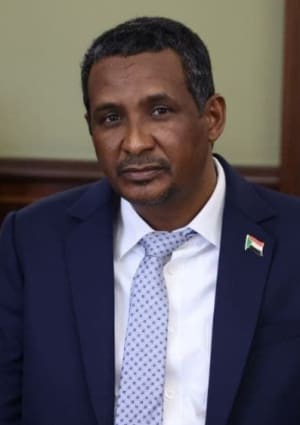
Mohamed Hamdan Dagalo, commonly known as Hemedti, is a Sudanese military commander and politician who serves as the commander of the Rapid Support Forces (RSF), a powerful paramilitary organization in Sudan. He served as Deputy Chairman of the Sovereignty Council of Sudan from 2019 until the 2021 Sudanese coup d'état.
NEW: Trump adviser Massad Boulos says the United States sees no political future for either of Sudan’s warring generals, army chief Abdel Fattah Al Burhan or RSF commander Mohamed Hamdan Dagalo.
The U.S. is backing a rapid civilian transition that excludes both men from Sudan’s postwar leadership.
SUDAN WAR UPDATE: Sudan is sliding toward partition.
The army, led by Abdel Fattah al Burhan and supported by Muslim Brotherhood aligned militias, controls Khartoum and most of northern, eastern and central Sudan. The RSF, led by Hemedti, ...
SUDAN WAR UPDATE: Sudan is sliding toward partition.
The army, led by Abdel Fattah al Burhan and supported by Muslim Brotherhood aligned militias, controls Khartoum and most of northern, eastern and central Sudan. The RSF, led by Hemedti, controls most of Darfur and operates a parallel government from Nyala.
Sudan is especially important because it sits along more than 800 kilometers of Red Sea coastline, overlooking the shipping route connecting the Suez Canal with Bab el Mandeb and the Indian Ocean.
Kordofan is now the decisive front. The army (SAF) has recently advanced in North Kordofan, while the RSF still holds positions farther west and uses drones to strike deep inside government territory.
At least 59,000 people have been killed, although the real toll is likely far higher. Around 13 million have been displaced, while parts of Darfur and Kordofan face famine.
Egypt, Iran, Pakistan and Turkey support the SAF. The RSF has been reported to receive support through networks linked to the UAE, Chad and Libya. The UAE denies arming it.
Saudi Arabia wants to host a national dialogue, frustrating Burhan, who wants the process held inside Sudan under his control. Meanwhile, the U.S. is pushing to expand the Darfur arms embargo across the entire country, covering the RSF and SAF, combat drones and loitering munitions.
Neither side is close to total victory. The immediate danger is a permanent division between an army controlled east and an RSF controlled west.
150,000 dead, 14 million displaced: The story of Sudan’s war
An estimated 150,000 people have been killed and more than 14 million displaced. Sudan’s current war has become one of the world’s worst humanitarian disasters, with 2 rival fact...
150,000 dead, 14 million displaced: The story of Sudan’s war
An estimated 150,000 people have been killed and more than 14 million displaced. Sudan’s current war has become one of the world’s worst humanitarian disasters, with 2 rival factions, both accused of widespread atrocities, fighting for control of the country.
The conflict has just entered its 4th year. It began in April 2023 when a fragile power-sharing arrangement between the Sudanese Armed Forces led by Abdel Fattah al-Burhan and the Rapid Support Forces commanded by Mohamed Hamdan Dagalo collapsed into open warfare. What began as a struggle between 2 former allies has devastated the country.
The 2 sides had jointly helped remove former ruler Omar al-Bashir in 2019 and later shared power after a military takeover in 2021. But tensions deepened over plans to merge the RSF into the regular army, command structures, and control of Sudan’s political transition, eventually erupting into war in the capital Khartoum.
The conflict has since spread across Darfur, Kordofan and central Sudan. Cities, hospitals, markets and infrastructure have been destroyed, while famine and acute hunger have spread across several regions.
Both factions have been accused by rights groups of ethnic killings, rape, looting, indiscriminate attacks and blocking aid.
Diplomatically, neither side offers a clean option. The RSF, rooted in the Janjaweed militias tied to past Darfur atrocities, has faced severe accusations of massacres and ethnic killings. The SAF has also been accused of strikes on civilian areas and other abuses. Some Western governments are seen as more open to the RSF, while the SAF faces scrutiny over Islamist influence, Muslim Brotherhood links and Iranian IRGC support. Bottom line, neither side are heroes.
And there is no end in sight.
How likely are you to recommend this site to a friend or colleague?