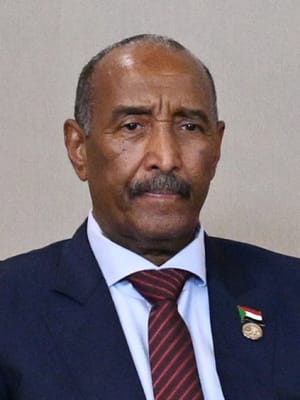
Head of State Sudanese

Abdel Fattah al-Burhan

Also known as al-Burhan

Abdel Fattah al-Burhan is the President of the Sovereignty Council of Sudan and de facto head of state. Known for leading the Sudanese Armed Forces against the RSF in a civil war that has produced one of the world's worst humanitarian crises. Recently, the conflict has entered its fourth year with massive casualties and displacement amid international scrutiny over arms flows. Last updated Jul 5th, 2026
Abdel Fattah al-Burhan

Latest coverage

Operations

Sudan’s war is intensifying on 2 fronts.

The SAF and allied Joint Forces have reportedly captured several positions in Kordofan, threatening RSF supply routes from Darfur. Meanwhile, the RSF and SPLM-N claim advances in Blue Nile, near Dam...

Sudan’s war is intensifying on 2 fronts.

The SAF and allied Joint Forces have reportedly captured several positions in Kordofan, threatening RSF supply routes from Darfur. Meanwhile, the RSF and SPLM-N claim advances in Blue Nile, near Damazin.

SAF commander Gen. Abdel Fattah al-Burhan, whose military has ties to Muslim Brotherhood aligned factions, has rejected U.S. and Quad ceasefire proposals and any political arrangement that would return RSF leaders to power. He has vowed to continue military operations until the RSF is defeated or surrenders.

The humanitarian toll continues to grow, with the UN warning that 15.4 million people urgently need shelter as aid supplies run out.

The UAE faces allegations of supporting the RSF, while Turkey, Iran, Russia and Egypt have been linked to SAF support.

Trump adviser Massad Boulos says at least 12 countries are providing military assistance to Sudan’s warring parties.

Signals

Planet Satellite imagery reveals extensive destruction at Amiet Market in Abyei, Sudan following last weeks drone strike that killed at least 153 people.

The images show burned buildings and widespread fire damage.

South Sudanese officials blamed Sudan’s Armed Forces under General al-Burhan. A SAF officer said the military targeted fuel tankers supplying the RSF, claiming the market itself was not the intended target.

Via AllSource Analysis / Planet

Leaders

Gen. Abdel Fattah al Burhan, leader of the Sudanese Armed Forces, whose war effort is backed by powerful Islamist factions, was supposed to address the UN General Assembly in New York. He never got his U.S. visa.

Reuters reports Washington tied the visa to Burhan accepting a U.S. backed 90 day ceasefire. Burhan refused.

Burhan responded publicly to the U.S. pressure.

“No one can blackmail us, no one can intimidate us, and no one has any hold over us,” he said.

Global

NEW: Trump adviser Massad Boulos says the United States sees no political future for either of Sudan’s warring generals, army chief Abdel Fattah Al Burhan or RSF commander Mohamed Hamdan Dagalo.

The U.S. is backing a rapid civilian transition that excludes both men from Sudan’s postwar leadership.

Aka NO RSF, and NO SAF.

Operations

SUDAN WAR UPDATE: Sudan is sliding toward partition.

The army, led by Abdel Fattah al Burhan and supported by Muslim Brotherhood aligned militias, controls Khartoum and most of northern, eastern and central Sudan. The RSF, led by Hemedti, ...

SUDAN WAR UPDATE: Sudan is sliding toward partition.

The army, led by Abdel Fattah al Burhan and supported by Muslim Brotherhood aligned militias, controls Khartoum and most of northern, eastern and central Sudan. The RSF, led by Hemedti, controls most of Darfur and operates a parallel government from Nyala.

Sudan is especially important because it sits along more than 800 kilometers of Red Sea coastline, overlooking the shipping route connecting the Suez Canal with Bab el Mandeb and the Indian Ocean.

Kordofan is now the decisive front. The army (SAF) has recently advanced in North Kordofan, while the RSF still holds positions farther west and uses drones to strike deep inside government territory.

At least 59,000 people have been killed, although the real toll is likely far higher. Around 13 million have been displaced, while parts of Darfur and Kordofan face famine.

Egypt, Iran, Pakistan and Turkey support the SAF. The RSF has been reported to receive support through networks linked to the UAE, Chad and Libya. The UAE denies arming it.

Saudi Arabia wants to host a national dialogue, frustrating Burhan, who wants the process held inside Sudan under his control. Meanwhile, the U.S. is pushing to expand the Darfur arms embargo across the entire country, covering the RSF and SAF, combat drones and loitering munitions.

Neither side is close to total victory. The immediate danger is a permanent division between an army controlled east and an RSF controlled west.

Alerts

NYT and The Washington Post obtained a dossier of internal documents, texts, voice notes, and test footage showing Sudan's army built chlorine bombs, tested them in the desert, and stockpiled about 300.

The weapons were used at Garri base and the Jaili refinery in 2024. The US sanctioned General Al-Burhan in January 2025.

Using chemical weapons is a war crime under the CWC.

Alerts

WATCH: SUDAN: Days after the U.S. imposed a second round of sanctions on Sudan, saying it had determined the Sudanese Armed Forces (SAF), led by General al Burhan, used chemical weapons during the Sudanese civil war, residents in Umm Garfa,...

WATCH: SUDAN: Days after the U.S. imposed a second round of sanctions on Sudan, saying it had determined the Sudanese Armed Forces (SAF), led by General al Burhan, used chemical weapons during the Sudanese civil war, residents in Umm Garfa, North Kordofan, shared footage of what they claim was the aftermath of an SAF Antonov dropping munitions.

Witnesses said the munitions released thick yellow smoke, prompting some to claim it was some sort of chemical attack.

(Please note: the color and smoke ring are not evidence of a chemical weapon. Chemical use usually cannot be confirmed from footage alone and requires forensic investigation.)

Alerts

The UAE has referred 13 defendants and 6 UAE registered companies to its State Security Court over an alleged Muslim Brotherhood linked network accused of smuggling weapons and millions of rounds of ammunition to Sudan’s army, after interce...

The UAE has referred 13 defendants and 6 UAE registered companies to its State Security Court over an alleged Muslim Brotherhood linked network accused of smuggling weapons and millions of rounds of ammunition to Sudan’s army, after intercepting a shipment at an airport before private jet transfer.

Attorney General Hamad Saif Al Shamsi said the cargo was labeled as humanitarian aid but contained ammunition, part of a covert pipeline using UAE companies, forged documents, and financial channels. Prosecutors linked the procurement structure to a committee chaired by Abdel Fattah al-Burhan, with Yasser Al Atta and Salah Gosh among those referred to court.

Alerts

150,000 dead, 14 million displaced: The story of Sudan’s war

An estimated 150,000 people have been killed and more than 14 million displaced. Sudan’s current war has become one of the world’s worst humanitarian disasters, with 2 rival fact...

150,000 dead, 14 million displaced: The story of Sudan’s war

An estimated 150,000 people have been killed and more than 14 million displaced. Sudan’s current war has become one of the world’s worst humanitarian disasters, with 2 rival factions, both accused of widespread atrocities, fighting for control of the country.

The conflict has just entered its 4th year. It began in April 2023 when a fragile power-sharing arrangement between the Sudanese Armed Forces led by Abdel Fattah al-Burhan and the Rapid Support Forces commanded by Mohamed Hamdan Dagalo collapsed into open warfare. What began as a struggle between 2 former allies has devastated the country.

The 2 sides had jointly helped remove former ruler Omar al-Bashir in 2019 and later shared power after a military takeover in 2021. But tensions deepened over plans to merge the RSF into the regular army, command structures, and control of Sudan’s political transition, eventually erupting into war in the capital Khartoum.

The conflict has since spread across Darfur, Kordofan and central Sudan. Cities, hospitals, markets and infrastructure have been destroyed, while famine and acute hunger have spread across several regions.

Both factions have been accused by rights groups of ethnic killings, rape, looting, indiscriminate attacks and blocking aid.

Diplomatically, neither side offers a clean option. The RSF, rooted in the Janjaweed militias tied to past Darfur atrocities, has faced severe accusations of massacres and ethnic killings. The SAF has also been accused of strikes on civilian areas and other abuses. Some Western governments are seen as more open to the RSF, while the SAF faces scrutiny over Islamist influence, Muslim Brotherhood links and Iranian IRGC support. Bottom line, neither side are heroes.

And there is no end in sight.