The World Health Organization is a United Nations agency responsible for international public health coordination. Known for leading global disease outbreak responses, setting health standards, and declaring public health emergencies of international concern. Recently, WHO has managed a major Ebola outbreak in central Africa and monitored a pneumonic plague incident at a Russian research institute. Last updated 4 days ago
The World Health Organization says the risk to public health among the general population appears low, based on unofficial information received after a death at a plague research institute in Russia.
A mysterious death at Russia’s Anti Plague Institute in Siberia has triggered mass quarantines, conflicting official accounts and apparent efforts to restrict information.
Here is what we know:
• ...
RUSSIA PLAGUE SCARE: WHAT WE KNOW SO FAR
A mysterious death at Russia’s Anti Plague Institute in Siberia has triggered mass quarantines, conflicting official accounts and apparent efforts to restrict information.
Here is what we know:
• Darya Shipilova, 28, a laboratory technician at the Irkutsk Anti Plague Institute, developed severe pneumonia and died overnight on 1 to 2 October.
• The head of neighboring Buryatia publicly said she had died “possibly from the plague,” while stressing that the diagnosis had not been confirmed.
• Local reporting claimed Shipilova may have been exposed to Yersinia pestis, the bacterium that causes plague, while working in the laboratory. Russian federal authorities deny there was any laboratory accident.
• Nearly 200 contacts were identified. 189 were reportedly hospitalized for observation, while several hospitals were placed under quarantine.
• A major aluminum plant in Shelekhov introduced a mask mandate amid contradictory information surrounding the incident.
• Authorities in Baikalsk posted a warning telling residents to limit travel to Shelekhov. The warning was deleted roughly 2 hours later.
• Russian media outlet REN TV also removed reporting related to the incident.
• Moscow now says Shipilova died from “pneumonia of unknown etiology” and says testing found no pathogen connected to her laboratory work.
• No secondary plague cases have been confirmed. Tests among monitored contacts instead detected 2 COVID 19 cases and 2 rhinovirus cases.
WHY THIS MATTERS:
Pneumonic plague is the most dangerous form of plague. Unlike the more familiar bubonic form, pneumonic plague infects the lungs and can spread directly between people through respiratory droplets during close contact.
Without prompt antibiotic treatment, it can progress rapidly and is frequently fatal. The WHO says untreated pneumonic plague can be fatal within 18 to 24 hours after infection.
That makes any suspected case involving a worker at an anti plague laboratory particularly important to investigate and monitor.
The U.S. government is monitoring the situation and has called on Russia to provide accurate information.
BOTTOM LINE: Russia denies this was plague or a laboratory accident, and there are currently no confirmed secondary plague cases.
But the scale of the quarantine response, conflicting official statements and deletion of public warnings and media reports make the situation worth closely following.
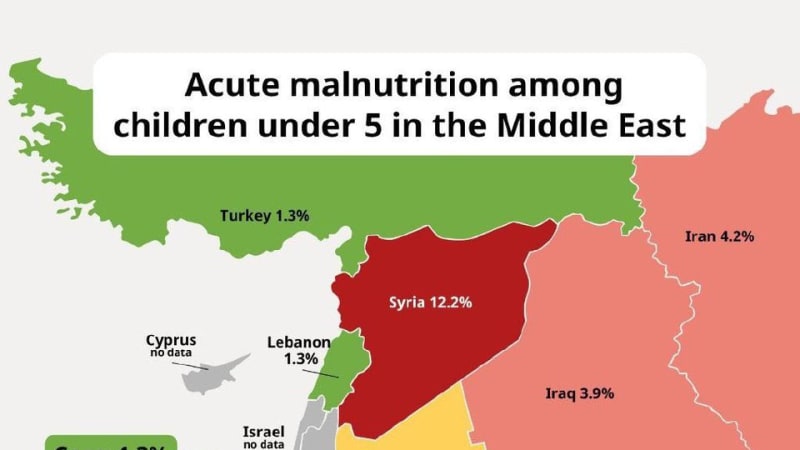
NEW: A UNICEF coordinated SMART survey conducted between May 31 and June 15 2026 found acute malnutrition in Gaza’s children under 5 at around 0.5%, ranging from 0.2% to 0.8% across governorates.
The rate is below Gaza’s prewar baseline of...
NEW: A UNICEF coordinated SMART survey conducted between May 31 and June 15 2026 found acute malnutrition in Gaza’s children under 5 at around 0.5%, ranging from 0.2% to 0.8% across governorates.
The rate is below Gaza’s prewar baseline of 0.8%, far below the WHO emergency threshold of 5%, and places Gaza in IPC Acute Malnutrition Phase 1 (Acceptable).
By comparison, reported rates are around 3% in Egypt, 0.6% to 2.4% in Jordan, 5%+ in Syria, and 4% to 6% in Bulgaria.
Four out of five Ebola patients in the ongoing Congo outbreak have no traceable source of infection, a senior WHO official warns. The real case count could be "two or three times" higher than current field figures. - Reuters
Canada has now tightened entry screening measures for travelers arriving from regions impacted by the Ebola outbreak.
‘Health officials’ say the outbreak has already caused hundreds of suspected cases and more than 220 suspected deaths, the WHO declares it a ‘global health emergency.’
"I think they failed miserably during Covid. They covered for China, and that’s why we’re getting out of it... Our number one objective on Ebola... we can’t have it affect the United States. We can’t have Ebola cases coming here."
The World Health Organization confirms there are no approved vaccines for the Bundibugyo strain of Ebola. Two candidate vaccines are currently in the pipeline.
WHO opposes the U.S. travel ban on Ebola-affected countries, recommending contact tracing instead. The virus is not airborne and spreads only through direct contact with blood or body fluids. Travel restrictions are "not supported under the IHR recommendations."
The World Health Organization (WHO) declared an international health emergency over a rare strain of Ebola that killed dozens in the Democratic Republic of Congo but stopped short of calling the outbreak a pandemic.
"WHO...is hereby determining that the Ebola disease caused by Bundibugyo virus in the Democratic Republic of the Congo and Uganda constitutes a public health emergency of international concern (PHEIC), but does not meet the criteria of pandemic emergency."
WHO Director-General Tedros says additional Hantavirus cases are expected due to the delay between the first infection and identification of the virus. Passengers continued interacting on the ship during that window.


 Russia
Shelekhov
Siberia
 United States