Also known as
Iran National Security Council, Supreme Council for National Security
Iran's Supreme National Security Council is the primary governmental body responsible for national security and foreign policy decisions, established in 1989. Known for coordinating Iran's strategic responses to external threats, overseeing nuclear negotiations, and setting red lines on military and diplomatic matters. Recently, the council has managed Strait of Hormuz policy, led U.S. negotiations, and undergone a leadership change with Mohsen Rezaei appointed as secretary. Last updated 6 days ago
Units & sub-organizations
Mohammad Hossein ShamkhaniPolitician Ali ShamkhaniPolitician
Iran's Supreme National Security Council: "If a violation or offense occurs on the part of the US, countermeasures will be taken in accordance with a pre-determined plan."
Iranian Hardliner Calls for Assassinating Trump on U.S. Soil.
Brati, a supporter of Saeed Jalili the only member of Iran’s Supreme National Security Council (SNSC) who voted against the agreement has called for the assassination of U.S. Pr...
Iranian Hardliner Calls for Assassinating Trump on U.S. Soil.
Brati, a supporter of Saeed Jalili the only member of Iran’s Supreme National Security Council (SNSC) who voted against the agreement has called for the assassination of U.S. President Donald Trump inside the United States.
In his remarks, Brati described the second point of the MOU, which emphasizes mutual respect for national sovereignty, territorial integrity, and non-interference in each other’s internal affairs, as treason.
He added: We do not respect America’s sovereignty. We must kill Trump on American soil.
As you have been informed, a memorandum of understanding was signed between the Presidents of Iran and the United States. On the path to reaching this stag...
Mojtaba Khamenei letter to the Iranians:
“The passionate and loyal nation of Iran,
As you have been informed, a memorandum of understanding was signed between the Presidents of Iran and the United States. On the path to reaching this stage, the officials, out of sincerity and goodwill, made many efforts, and of course, it was the U.S. President who, out of desperation, used various leverage for this matter.
I basically had a different opinion, but due to the commitment that the honorable President, as the head of the Supreme National Security Council, gave me on behalf of himself and other members in safeguarding the rights of the Iranian nation and the Resistance Front, and explicitly accepted responsibility for it, I granted permission.
He has also stated that if the American side wants to be excessive, they will not accept it.
From this moment, we, meaning you proud nation and this humble servant, will await the fulfillment of the stated conditions.
However, it is obvious that future face to face negotiations will not mean acceptance of the enemy’s opinion.
We hope that the prayers of our master, may God hasten his noble reappearance, bring all kinds of victories and triumphs to the honorable nation of Iran.
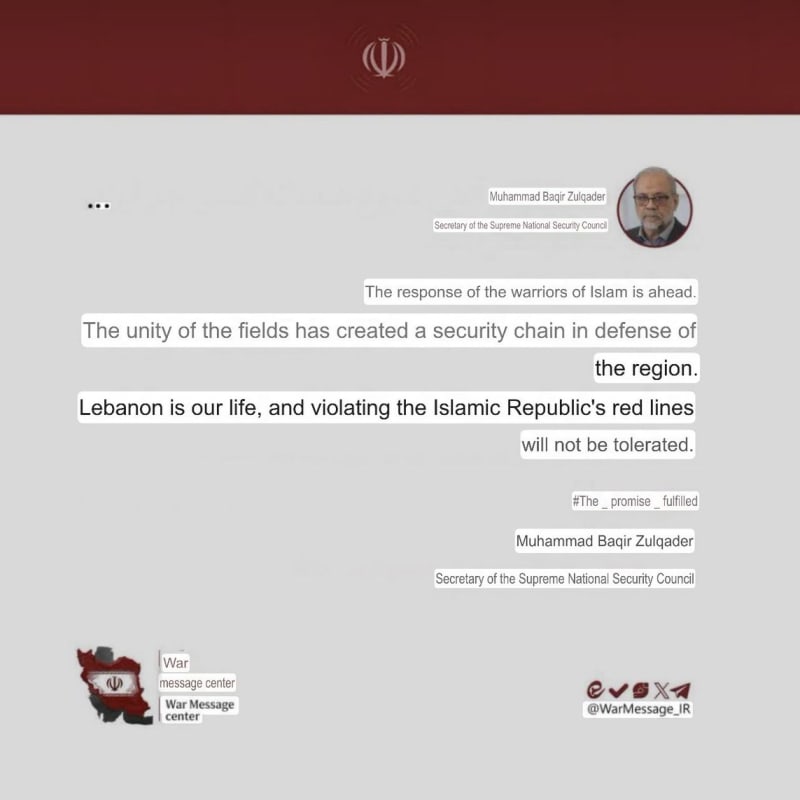
Secretary of the Supreme National Security Council, Mohammad Bagher Zolghadr:
“The response of the Islamic warriors is on the way. The unity of the fronts has created a security chain to defend the region.
Lebanon is our breath of life, and the crossing of the Islamic Republic’s red lines will not be tolerated.”
Iranian President Masoud Pezeshkian announced that the Supreme National Security Council(SNSC) has concluded the country should pursue the path of dialogue.
Iran's parliament continues to hold sessions via webinar after the Supreme National Security Council did not reply to Speaker Ghalibaf's request for authorization to return to in-person meetings, parliamentary spokesman Abbas Goudarzi said.
Iranian media says Tehran has begun implementing its plan to charge ships transiting the Strait of Hormuz, with vessels reportedly paying $1.5 million to $2 million per transit through a system overseen by Iran’s Supreme National Security Council.
Payments are said to include cash, goods, services, and Tether (crypto).
A small but vocal hard-line faction in Iran with parliamentary members and a seat on the Supreme National Security Council is pushing to derail any agreement with Washington, leveraging rallies, state media, and private lobbying. - WSJ,
“The Strait of Hormuz isn't closed by a tweet to be opened by a tweet, The path to opening the Strait of Hormuz is either accepting defeat, reaching an agreement, and acknowledging Iran's sovereignty and supremacy over the Strait of Hormuz, Or returning to the battlefield, accepting another humiliating defeat, and acknowledging Iran's sovereignty and supremacy over the Strait of Hormuz, No path remains other than this.
Iran’s Supreme National Security Council, led by Mohammad Baqer Zolqadr, reportedly warned that anti regime protests could resume within days as the economy deteriorates. Officials said economic pressure is the main trigger.
The assessment...
Iran’s Supreme National Security Council, led by Mohammad Baqer Zolqadr, reportedly warned that anti regime protests could resume within days as the economy deteriorates. Officials said economic pressure is the main trigger.
The assessment claimed Iran may only withstand another 6 to 8 weeks of a U.S. naval blockade. By the end of spring, up to 2 million private sector jobs could be lost. Security officials reportedly concluded unrest is inevitable, with only the timing uncertain. - Iran International
The United States has been forced to accept Iran’s 10-point proposal, which includes: a fundamental commitment to non-aggression, continued Iranian control over the Strait of Hormuz, acceptance of ...
Iran's Supreme National Security Council:
The United States has been forced to accept Iran’s 10-point proposal, which includes: a fundamental commitment to non-aggression, continued Iranian control over the Strait of Hormuz, acceptance of uranium enrichment, lifting all primary and secondary sanctions, termination of all UN Security Council and Board of Governors resolutions, compensation to Iran, withdrawal of U.S. combat forces from the region, and cessation of war on all fronts, including against the Islamic resistance in Lebanon.
Iran has appointed Mohammad Baqer Zolqadr, a retired Islamic Revolutionary Guard Corps commander, as the new Secretary‑General of its Supreme National Security Council, replacing Ali Larijani, who was killed in a recent strike.
Reuters: The U.S. has requested a meeting with Iran’s parliament speaker Qalibaf on Saturday, a senior Iranian official said, without specifying a location. Iran has yet to respond, and its Supreme National Security Council has not made a decision on the proposed talks.
Hossein Dehghan, the former defense minister, has been appointed as the Secretary of the Supreme National Security Council in place of Ali Larijani - reports