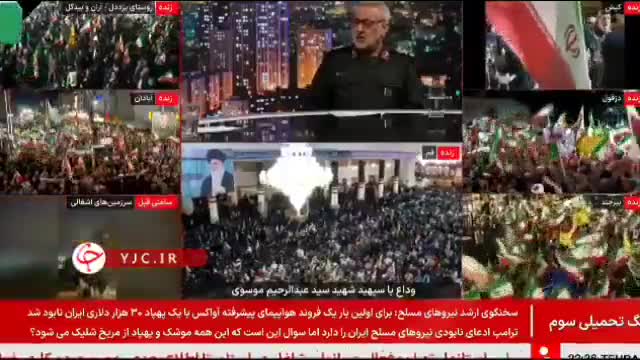
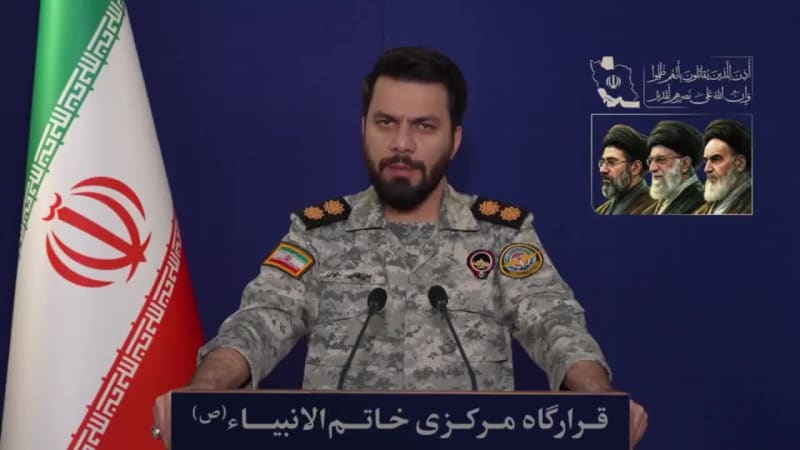
Iran's Armed Forces Chief of the General Staff Abdullahi warned that Iranian forces "will respond to any level and type of threat with an immediate, significant response and without geographical limitations." He added that Iran's strategy "has shifted from defense to an offensive initiative and from managing crises to creating order," while insisting "Iran does not want war."
"Right now, Americans are 500 km away from our shores and we will carry out operational plans to push them beyond that. They no longer dare to come closer"
A senior spokesman for Iran's Armed Forces warned that any vessel transiting the Strait of Hormuz outside the route set by Tehran will not be safe, according to Fars News.
"Hostile media outlets are placed in our military target bank. Networks like BBC, Iran International, and Radio Farda are directly connected to Mossad, the CIA, and enemy intelligence agencies. They receive their directives and support from them.
Iran's Armed Forces do not view these outlets as media. They are soldiers of the Zionists and America, and they are placed in our military target bank."
Ali Abdullahi, Chief of the General Staff of the Iranian Armed Forces:
"The countries on the southern shores of the Persian Gulf, which declare they will not allow the United States to use their territory against Iran, should know that not...
Ali Abdullahi, Chief of the General Staff of the Iranian Armed Forces:
"The countries on the southern shores of the Persian Gulf, which declare they will not allow the United States to use their territory against Iran, should know that nothing is hidden from our eyes. It is improbable that military aircraft of this scale, especially refueling aircraft, are at bases in the area without the knowledge of the host countries. We warn: any aid or relief to the aggressor American military is considered partnership alongside American military forces."
Iranian armed forces: "The Strait of Hormuz is CLOSED, and any passage will be possible only in coordination with Iranian naval forces. CENTCOM falsely claims traffic is continuing and that shipping companies can cross the strait without difficulty under US military escort."
If U.S. attacks continue over the next two to three days, the Armed Forces of the Islamic Republic of Iran will move beyond the stage of deterrence and retaliation and enter the phase of “offense and ...
Senior Iranian official Mohsen Rezaee:
If U.S. attacks continue over the next two to three days, the Armed Forces of the Islamic Republic of Iran will move beyond the stage of deterrence and retaliation and enter the phase of “offense and complete destruction,” such that U.S. bases and soldiers beyond political borders will be pursued and directly targeted.
The United States should know that the attritional strategy of “war and negotiation” has reached a dead end, and in the coming days, the intensity of Iran’s attacks will increase.
The Iranian Armed Forces say they launched attack against U.S. military sites in Kuwait, Bahrain, and Jordan, claiming to have targeted radar and air defense systems.
"Even during the implementation of the agreement, we will continue to strengthen our defensive capabilities, and we will maintain the readiness level of our forces more than ever before - in orde...
Iranian military spokesman, full statement:
"Even during the implementation of the agreement, we will continue to strengthen our defensive capabilities, and we will maintain the readiness level of our forces more than ever before - in order to compel the enemy to implement the clauses of the agreement and fulfill its commitments."
"We will support any understanding or agreement that secures the interests of the Iranian people, but we believe that the enemy's fulfillment of its obligations requires the application of force."
"If the enemy violates the clauses of the agreement or the memorandum of understanding, we will swiftly and forcefully restore the military situation in the region to the conditions that prevailed before the agreement."
The son of Abdolrahim Mousavi, head of the General Staff of the Armed Forces of the Islamic Republic, revealed that his father's body was buried under rubble for nearly 30 days. Mousavi was killed on the first day of U.S. and Israeli attacks targeting Khamenei's office.
Mousavi had only recently been appointed Chief of the General Staff after his predecessor, Mohammad Bagheri, was killed during the 12-day war.
The aggressive, terrorist, and pirate U.S. military violated the ceasefire by targeting an Iranian oil tanker traveling from Iran’s coastal waters near Jask toward the Strait of Hormuz, as well as another vessel enteri...
IRAN ARMY SPOX FULL;
The aggressive, terrorist, and pirate U.S. military violated the ceasefire by targeting an Iranian oil tanker traveling from Iran’s coastal waters near Jask toward the Strait of Hormuz, as well as another vessel entering the Strait of Hormuz near the Emirati port of Fujairah.
At the same time, with the cooperation of some regional countries, they carried out air attacks on civilian areas along the coasts of Bandar Khamir, Sirik, and Qeshm Island.
The Armed Forces of the Islamic Republic of Iran immediately responded by attacking U.S. military vessels east of the Strait of Hormuz and south of the port of Chabahar, reportedly inflicting significant damage on them.
The Iranian Armed Forces (Khatam al-Anbiya) spokesman:
We will begin targeting the homes of American and Israeli commanders and political officials in the region and in Israel, in response to attacks on our people and leaders in residential areas in Iran.