Prince Sultan Air Base is a military air base located in Al Kharj, Saudi Arabia. Known as a key U.S. forward operating hub in the Gulf, hosting American air assets and supporting regional power projection since the 1990s. Recently, the base was struck by Iranian missiles, sustaining damage to U.S. aircraft, and has remained active amid continued regional missile threats. Last updated 2 days ago
RIYADH AIRPORT: Terminal 4 struck for the 2nd time in 24 hours. What we know so far.
Saturday, October 10:
A missile struck the domestic terminal complex at King Khalid International Airport, affecting Terminals 3 and 4 and triggering a m...
RIYADH AIRPORT: Terminal 4 struck for the 2nd time in 24 hours. What we know so far.
Saturday, October 10:
A missile struck the domestic terminal complex at King Khalid International Airport, affecting Terminals 3 and 4 and triggering a mass evacuation.
Saudi aviation officials reported at least 12 killed and 309 wounded, including several in serious condition.
The dead included 4 Saudis, 2 Bangladeshis and citizens of the U.S., Egypt, Jordan, Syria, Palestine and Sudan.
Witnesses described a projectile approaching the airport before an explosion caused part of the ceiling near a departure gate to collapse.
Sunday, October 11:
Saudi coalition spokesman Turki al Malki said another projectile struck Terminal 4, igniting a fire.
The extent of the damage remains unclear. No additional casualty figures have been released.
Separately, the coalition reported intercepting a ballistic missile over Al Kharj, near Prince Sultan Air Base, while another projectile reportedly landed near King Fahd International Airport in Dammam.
The wider picture:
Attacks on Riyadh airport between October 8 and 10 killed at least 15 people and wounded more than 300.
On October 8, 3 Saudis were killed in strikes targeting airport facilities and a Saudia aircraft. The Houthis claimed to have launched 2 cruise missiles at the airport.
The Saudi coalition has described the attacks as a war crime and threatened a decisive response.
President Donald Trump condemned the strikes and said he was considering U.S. participation in Saudi military operations against the Houthis.
What remains unknown:
Saudi authorities have not identified the weapon used in Sunday’s strike, confirmed whether Terminal 4 was occupied at the time, or released a new casualty assessment.
The latest strike comes as Riyadh hosts the WPC Energy Congress, bringing together senior oil ministers and energy executives.
The airport is a civilian aviation facility, and no military installation has been identified within the terminal complex.
14 Russian military satellites passed over Prince Sultan Air Base in Saudi Arabia in the days before Iran struck it in late March, collecting imagery on March 20, 23 and 25.
The base hosts U.S. and Saudi personnel. A U.S. Air Force E-3 Sentry AWACS, relocated in advance to protect it, was severely damaged. American service members were wounded.
Saudi Arabia's Maj. Gen. Turki Al-Malki denied reports that Prince Sultan Air Base was targeted. The early Monday air raid alert in Al-Kharj Governorate was triggered by a Houthi ballistic missile launched from Yemen that disappeared near the border.
An E-3G Sentry AWACS (Airborne Warning and Control System) aircraft is airborne after departing Prince Sultan Air Base (PSAB), Saudi Arabia. Tail number: 82-0007.
Ukrainian personnel have arrived at Prince Sultan Air Base in Saudi Arabia to train U.S. soldiers on Sky Map, a Ukrainian-developed counter-drone command and control system. The base has been repeatedly hit by Iranian attacks. - Reuters
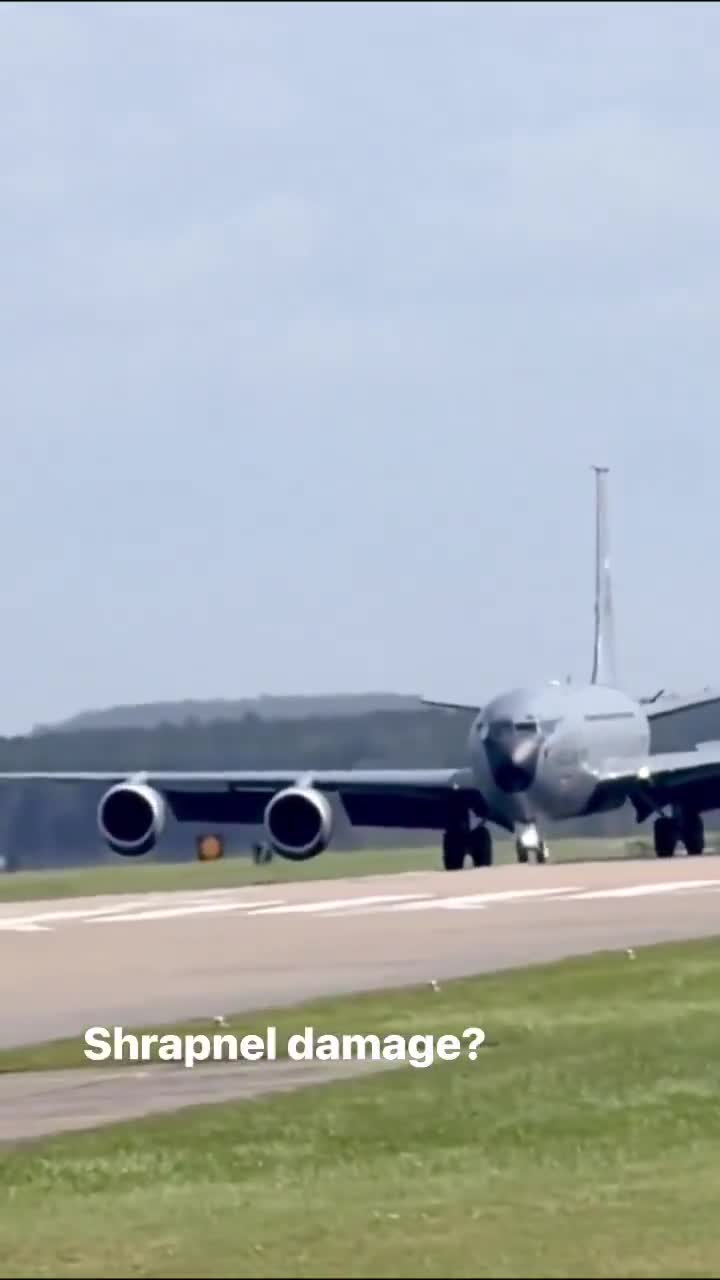
Unbelievable images of a U.S. KC-135R refueling aircraft, tail number 59-1444, which returned to the U.S. two days ago after operations in the Middle East as part of the campaign against Iran.
According to reports, the aircraft was hit in ...
Unbelievable images of a U.S. KC-135R refueling aircraft, tail number 59-1444, which returned to the U.S. two days ago after operations in the Middle East as part of the campaign against Iran.
According to reports, the aircraft was hit in an Iranian missile attack at Prince Sultan Air Base in Saudi Arabia. Other aircraft were also damaged, including an E-3 AWACS, which was completely destroyed.
The tanker made the entire journey back to the U.S., with stopovers, covered in tape from nose to tail.
A U.S. Air Force KC-135R Stratotanker damaged in an Iranian ballistic missile strike on Prince Sultan Air Base has arrived at RAF Mildenhall for repairs.
The aircraft shows visible shrapnel damage across its airframe. During the attack, the U.S. Air Force lost two KC-135Rs, one KC-46A Pegasus, and one E-3G Sentry at the base.
Iran releases satellite imagery claiming to show a destroyed U.S. Air Force E-3G Sentry AWACS aircraft at Prince Sultan Air Base in Saudi Arabia, before and after the March 27 strike.
Newly released photos appear to show a U.S. Air Force E-3 Sentry destroyed in an Iranian attack at Prince Sultan Air Base on Friday, matching tail number 81-0005, an E-3C deployed there in recent weeks.
10 U.S. service members were injured after an Iranian missile struck Prince Sultan Air Base in Saudi Arabia, damaging several U.S. refueling aircraft, WSJ reports.
IRGC claims it struck Israel Aerospace Industries near Ben Gurion and U.S. reconnaissance aircraft at Prince Sultan Air Base in Saudi Arabia with drones.
IRGC claims it targeted Prince Sultan Air Base, the U.S. Fifth Fleet in Bahrain, and Kurdish opposition group Komala with Emad, Fateh, and Qiam missiles and drones.
How likely are you to recommend this site to a friend or colleague?