


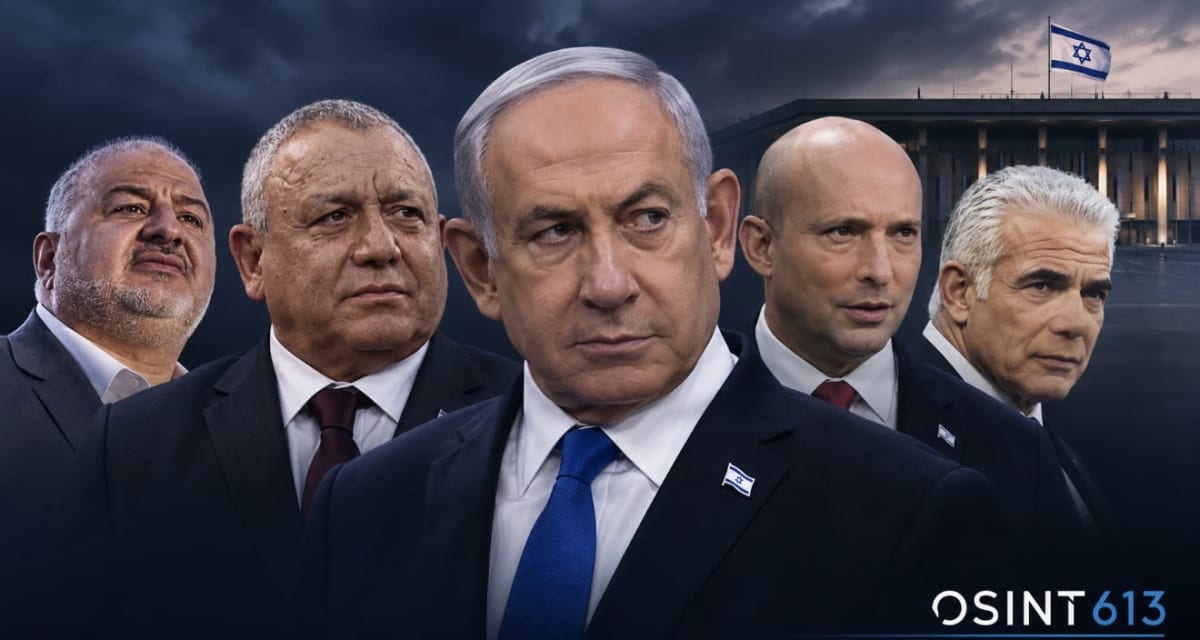
Prime Minister Netanyahu won the most seats in Israel’s October 27 election, but lost his parliamentary majority. Gadi Eisenkot has enough potential support to replace him, but the parties he needs have ruled out the coalition arrangements that would put him in power.
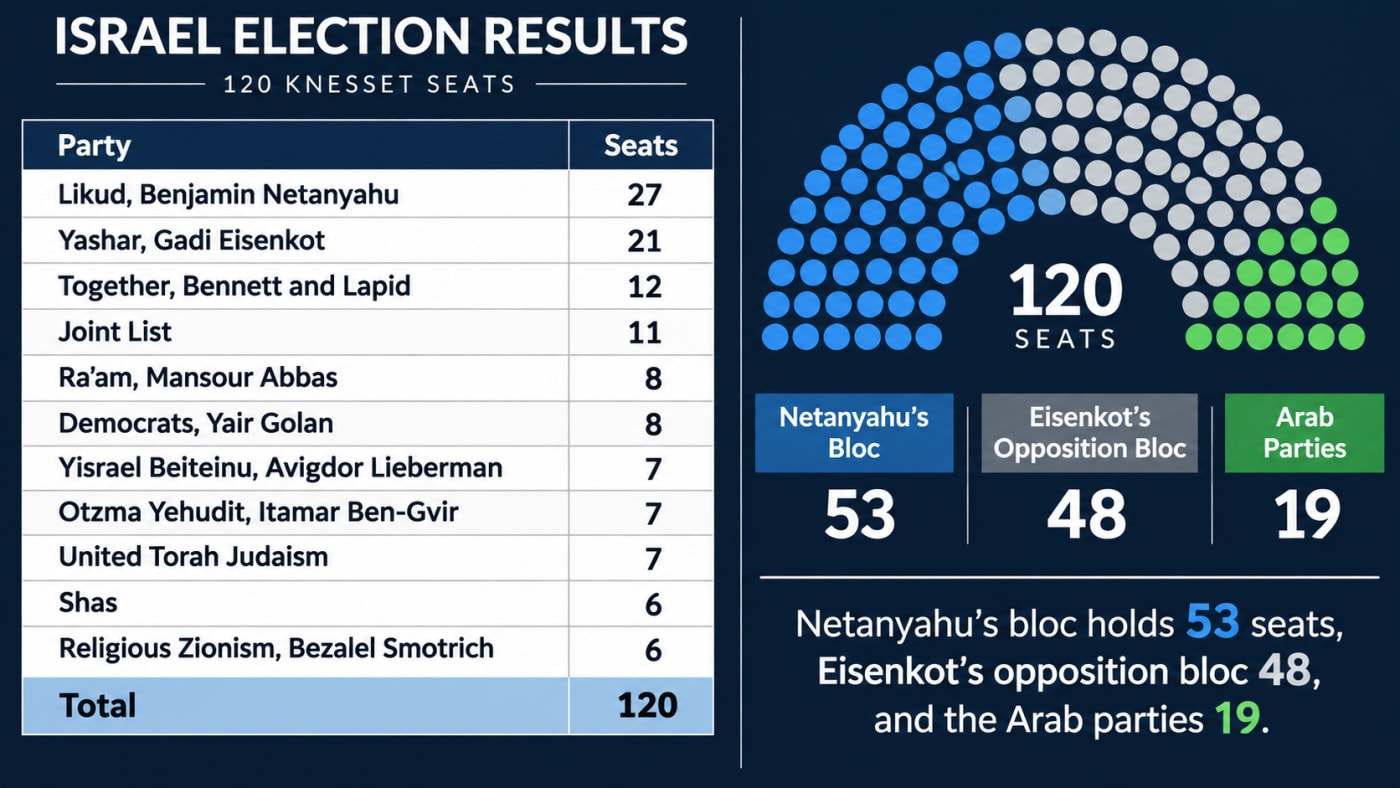
The near final results leave Netanyahu’s right wing and ultra Orthodox bloc with 53 seats, Eisenkot’s opposition bloc with 48, and the Arab parties holding 19.
Neither side has the 61 seats needed for an outright majority.
Eisenkot may receive the first opportunity to form a government, but his political allies have imposed restrictions that make it difficult. Naftali Bennett wants a Zionist coalition without Arab or ultra Orthodox parties. Avigdor Lieberman refuses to govern with Netanyahu, the Arab parties or the Haredim. Eisenkot himself has set conditions that complicate cooperation with all 3.
Meanwhile, the U.S. is considering renewed military operations against Iran following the November 3 midterm elections. A new war could begin as President Isaac Herzog starts consultations over Israel’s next government.
Netanyahu could find himself directing another war as caretaker prime minister while his opponents struggle to replace him.
The Election Results
The October 27 election produced the following near final distribution of the 120 Knesset seats.
National turnout reached approximately 77.9%, the highest since 1999.
Preliminary estimates put Arab voter turnout at approximately to 80%, compared with roughly 53% in 2022, an increase of approximately 27 percentage points.
In Rahat, turnout reached 82%, up from approximately 60% in the previous election. Reports from some Arab polling locations indicated participation as high as 95%, compared with roughly 50% in previous elections.
The Arab Joint List and the Arab Ra’am secured a combined 19 seats, compared with 10 seats won by Arab parties in 2022, a gain of 9.
The surge has prompted scrutiny, with 2 separate investigations underway into suspected foreign election interference and alleged voter bribery involving Arab political parties. We will examine both investigations later in this report.
Likud remains the largest party, but Netanyahu’s bloc suffered significant losses. Shas fell from 11 seats to 6, contributing to the loss of his parliamentary majority.
Why Eisenkot Cannot Build a Majority
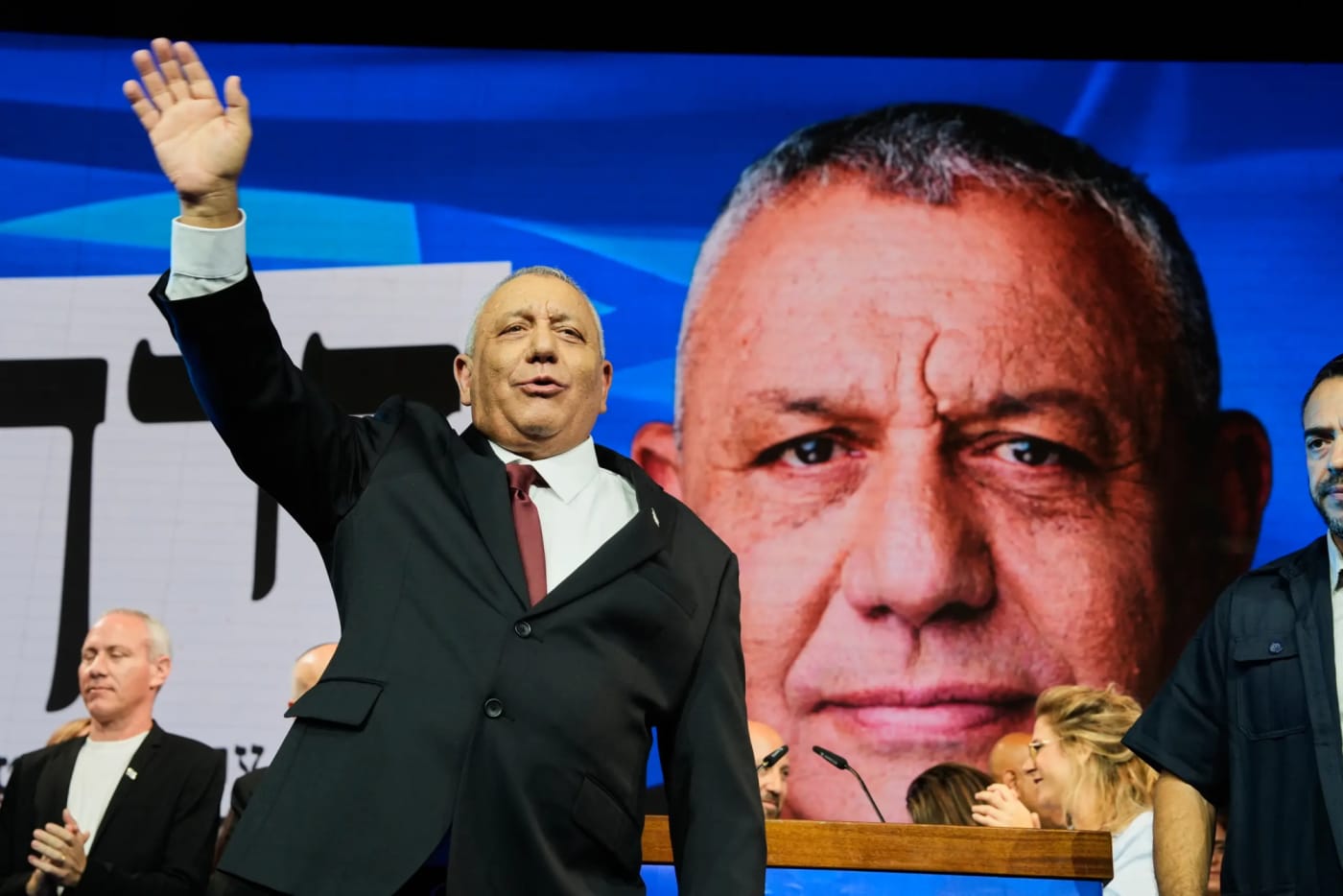
Gadi Eisenkot may receive the first opportunity to form Israel’s next government, but his path to 61 seats is blocked by his own political allies and campaign commitments.
His 4 party opposition bloc controls 48 seats, leaving him 13 short of an outright majority.
The Joint List and Ra’am hold 19 seats, enough to give Eisenkot a parliamentary majority if they and his entire opposition bloc support him. But Eisenkot has set conditions for cooperation with Arab parties, including recognition of Israel as a Jewish and democratic state and a clear position against Hamas.
Ra’am chairman Mansour Abbas has expressed willingness to join an alternative government, but his refusal to unequivocally designate Hamas a terrorist organization presents a major obstacle.
Eisenkot also campaigned for broader military conscription, putting him at odds with Shas and United Torah Judaism, which hold a combined 13 seats and oppose compulsory military service for Haredi yeshiva students.
Then there is Naftali Bennett.
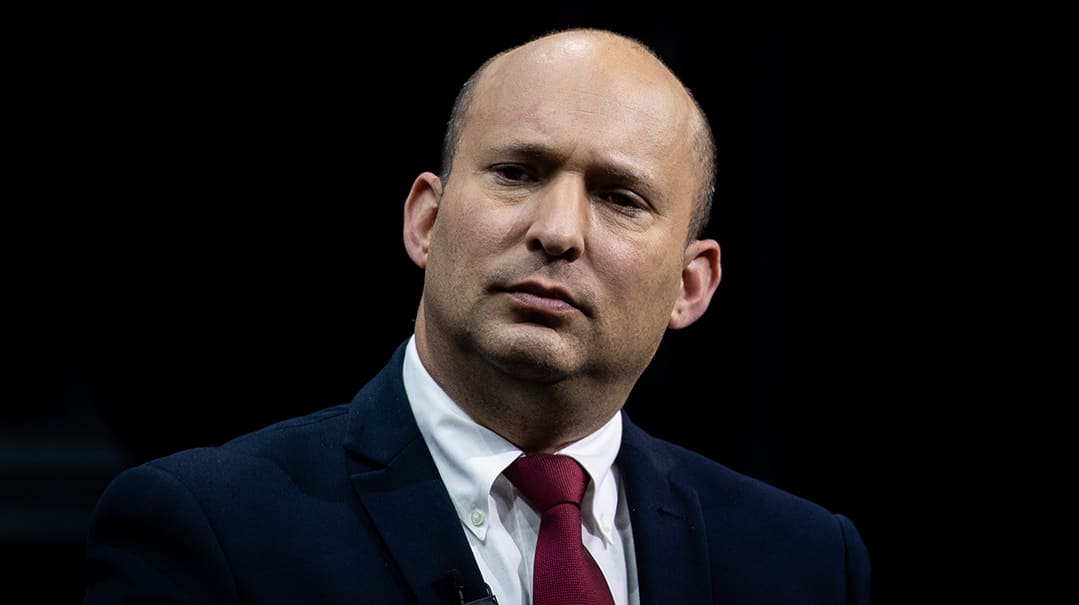
Bennett wants a government composed exclusively of Zionist parties, excluding Arab and ultra Orthodox factions.
The Arab parties reject the Zionist political framework Bennett requires. The Haredi parties have historically maintained a different relationship with political Zionism, prioritizing religious autonomy and their communities’ interests.
Without either group, Eisenkot’s opposition bloc remains at 48 seats. Bennett’s proposed coalition cannot reach 61 unless Likud joins or lawmakers defect from other parties.
Avigdor Lieberman presents another obstacle.
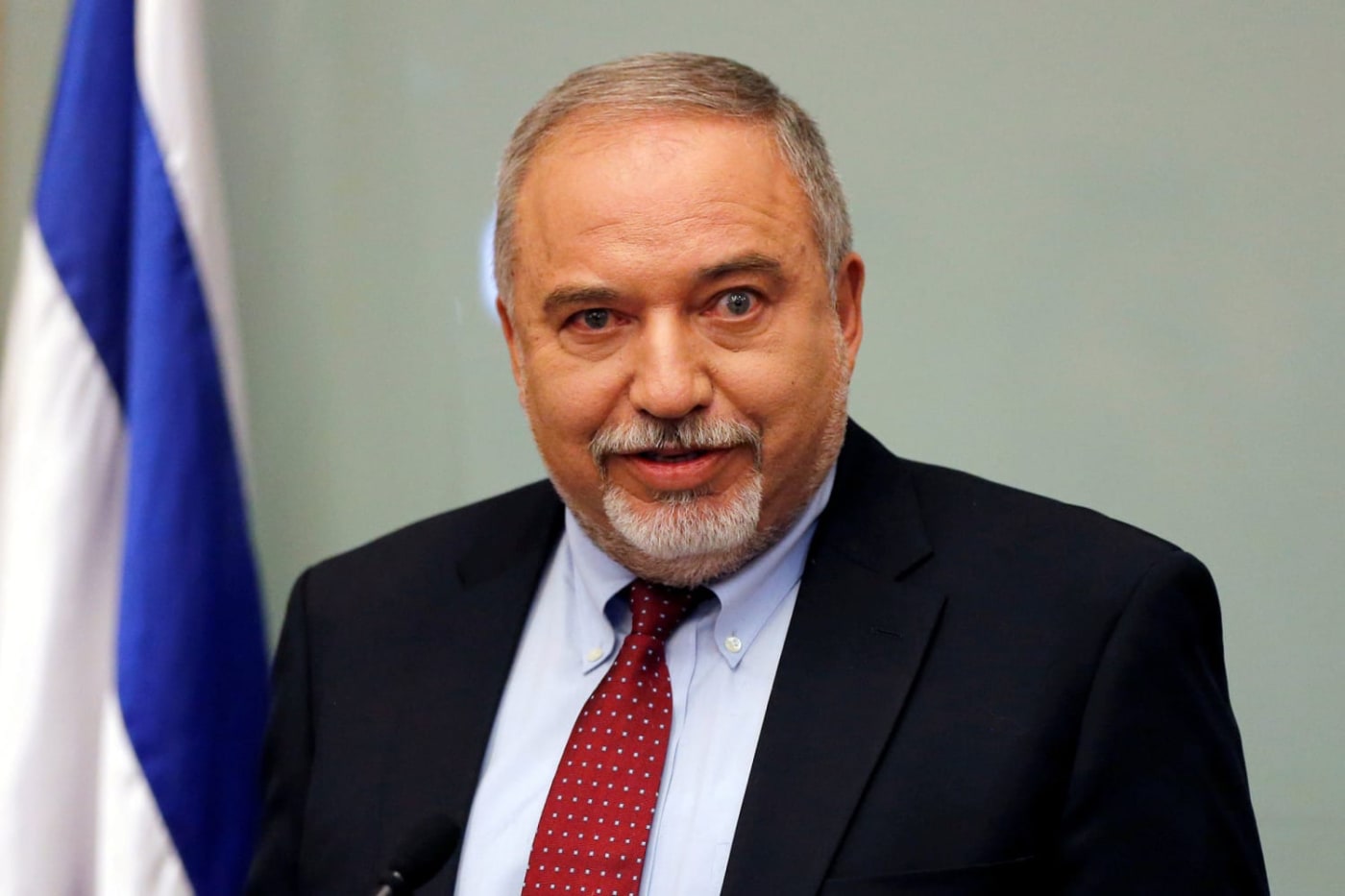
He refuses to govern with Netanyahu, opposes dependence on Arab parties, and has spent years campaigning against the political influence of Shas and United Torah Judaism.
His 7 seats are part of Eisenkot’s 48 seat bloc, but his conditions exclude the parties that could give Eisenkot an outright majority.
Yair Golan’s Democrats, with 8 seats, are more willing to cooperate with Arab parties, but cannot overcome Bennett’s and Lieberman’s objections.
Eisenkot could theoretically form a minority government with external Arab support, but that would require an agreement over which parties vote in favor, which abstain and which oppose it.
His potential parliamentary support is sufficient to replace Netanyahu. His problem is securing the votes needed to approve a government.
Who Gets the First Mandate?
President Isaac Herzog is expected to receive the official election results and begin consultations with party leaders on November 4.
Eisenkot could receive as many as 67 recommendations if the entire opposition bloc and both Arab parties endorse him.
Even without Lieberman’s 7 seats, he could reach 60.
Netanyahu is expected to receive at least 46 recommendations from Likud, Otzma Yehudit, Shas and Religious Zionism.
United Torah Judaism, with 7 seats, remains uncommitted. Its support would bring Netanyahu to 53.
Herzog is not required to select the leader of the largest party. He must determine which lawmaker has the best chance of forming a government.
The first candidate receives 28 days, with a possible 14 day extension. If that attempt fails, further coalition formation procedures follow.
Netanyahu remains caretaker prime minister throughout the process.
An endorsement for Eisenkot does not mean the recommending party will join his government. Arab lawmakers could recommend him while remaining outside the coalition, and Lieberman could support his candidacy while refusing a government dependent on Arab votes.
Eisenkot may therefore win the presidential mandate without securing the parliamentary votes needed to govern.
The Options for Forming a Government
Eisenkot’s most realistic alternative is a minority government supported by Arab lawmakers from outside the coalition.
Israeli law does not require 61 affirmative votes to approve a government. It requires more votes in favor than against.
Eisenkot’s 48 seat bloc, combined with Ra’am’s 8 seats, would produce 56 votes against Netanyahu’s 53 if the Joint List’s 11 lawmakers abstained.
But that assumes Bennett and Lieberman support the government.
If both refuse to support Eisenkot, his remaining opposition partners control only 29 seats. Adding Ra’am brings that to 37, against Netanyahu’s 53.
If Bennett and Lieberman abstain rather than vote against the government, their absence still leaves Eisenkot short under that arrangement. Additional abstentions or support from other parties would be required.
A minority government is legally possible, but Eisenkot cannot form one without either winning over reluctant allies or negotiating a broader voting arrangement.
A second option is a unity government involving Netanyahu and Eisenkot.
Netanyahu’s allies have reportedly explored a coalition including Eisenkot, Bennett and Lieberman alongside Likud, Otzma Yehudit and Religious Zionism, initially excluding Shas and United Torah Judaism.
Reported proposals include a rotation agreement or senior government positions for Eisenkot.
Eisenkot has rejected serving under Netanyahu, while Lieberman and Bennett have also campaigned against joining his government.
Ben-Gvir has criticized the proposal, warning that such an arrangement would become a “government of paralysis.”
Netanyahu could attempt to recruit opposition defectors or negotiate a narrower coalition. His 53 seat bloc is 8 seats short of an absolute majority, although a minority government could theoretically be approved with fewer than 61 affirmative votes if enough lawmakers abstained.
A third possibility is another election in 2027 if the coalition formation process fails.
The opposition is also considering replacing Knesset Speaker Amir Ohana after the new Knesset convenes on November 10. With Arab support, anti Netanyahu lawmakers could potentially control parliamentary votes before a new government is sworn in.
Likud has sharply opposed the proposal.
2 Investigations Into the Arab Vote
Israeli authorities are conducting 2 separate investigations following the sharp increase in Arab voter participation, examining suspected foreign interference and allegations that voters were offered money or other benefits in exchange for supporting Arab parties.
The first investigation involves the Shin Bet and reported Mossad assistance.
Central Elections Committee chairman Justice Noam Sohlberg instructed Shin Bet director David Zini to investigate intelligence suggesting foreign governments may have financed voter mobilization efforts through illegal channels.
Israeli media reports have focused on Qatar and Turkey, including allegations that tens of millions of shekels were transferred through intermediaries to influence Arab turnout.
Channel 14 analyst Perez has also claimed that Pakistan is among the countries being examined, but said additional details remain under Israeli military censorship. That claim has not been independently confirmed, and authorities have not publicly established Pakistani involvement.
The Mossad has reportedly joined the inquiry to examine suspected activity outside Israel.
Qatar and Turkey deny interfering in the election.
The second investigation involves suspected voter bribery.
Israeli police have arrested several suspects, including activists associated with Ra’am, over allegations that voters were offered money and other benefits in exchange for supporting the party.
Police reportedly seized envelopes containing cash and Ra’am ballot slips during operations in the Negev.
Images circulating online have also shown piles of used fuel cards at gas stations across the Negev, along with photographs reportedly showing hundreds of cards inside a vehicle.

Witnesses have alleged that fuel cards were distributed to Bedouin voters on election day. Channel 14 published accounts of unusually heavy traffic at gas stations, including near Shoket Junction, alongside allegations that voters received fuel vouchers.
The police investigation into suspected bribery involving Ra’am remains separate from the Shin Bet’s foreign interference inquiry.
Likud has accused foreign actors and Arab political organizations of stealing the election, but Israeli police and election officials have rejected allegations of widespread electoral fraud.
The Shin Bet says its investigation is based on intelligence collected independently, not information supplied by politicians.
The Central Elections Committee has also stated that the investigations are not expected to alter the allocation of Knesset seats or delay the submission of results to President Herzog.
The results could still face a legal challenge. Under Israeli election law, petitions challenging the published results may be filed with the courts within 14 days of publication.
Any challenge would need to establish legal grounds for intervention. The existence of an investigation or allegations of irregularities does not automatically invalidate votes or change the allocation of seats.
For Eisenkot, the political consequences could arrive before any criminal findings.
His potential majority depends on the 19 Arab lawmakers, while Bennett and Lieberman have already rejected governing with their support.
If investigators establish illegal foreign financing or organized voter bribery, the pressure on Eisenkot’s allies to maintain those commitments could increase considerably.
A New War With Iran Could Change the Negotiations
Israel’s political negotiations are approaching a potentially decisive moment in the confrontation between the U.S. and the Islamic regime.
The U.S. has warned Middle Eastern allies to prepare for possible renewed strikes against Iran after the November 3 midterm elections, and for Iranian retaliation against energy facilities and other critical infrastructure.
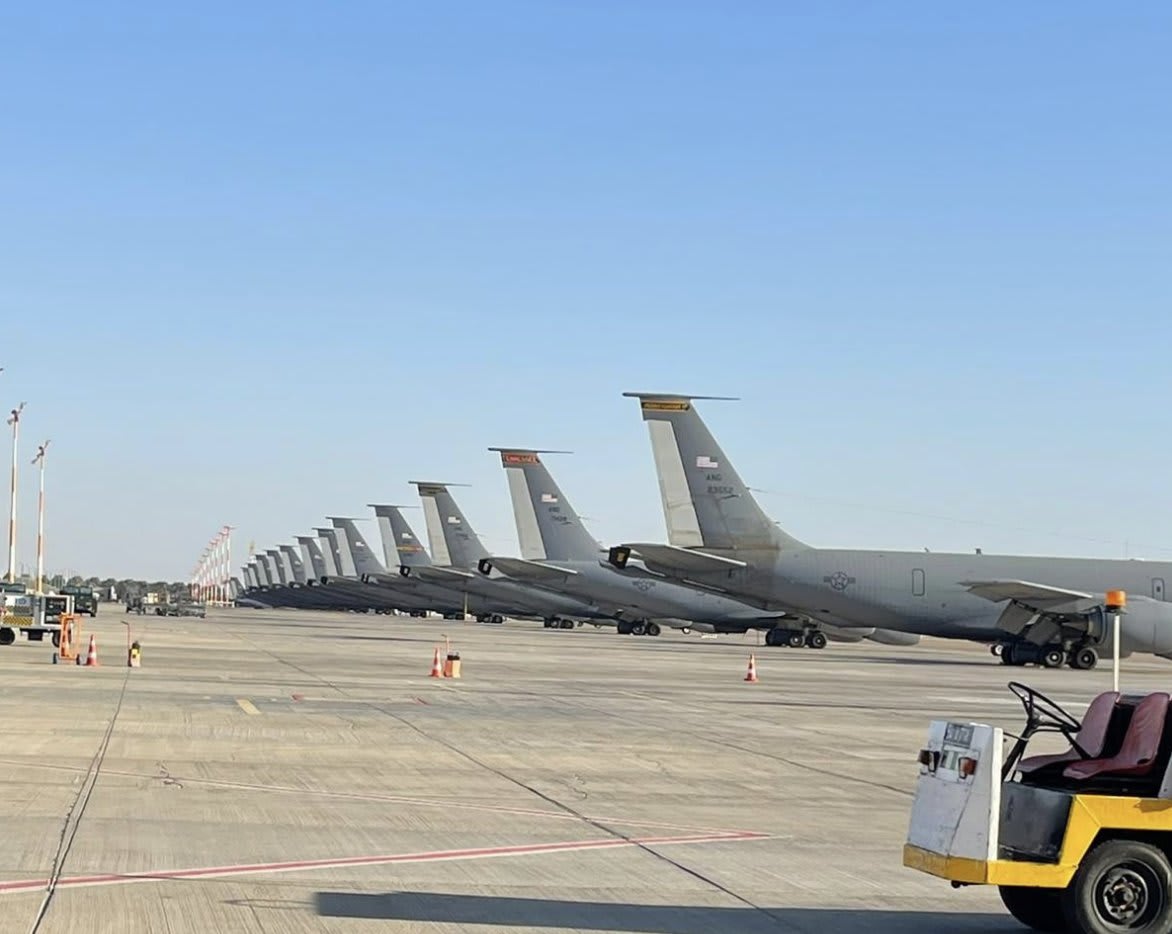
U.S., Israeli and regional officials reportedly believe another bombing campaign is increasingly likely unless diplomatic mediation produces a breakthrough.
November 4, the same day Herzog is expected to begin consultations, has been identified by Gulf officials as a possible opening for military operations.
President Donald Trump has not made a final decision.
Secretary of State Marco Rubio says diplomacy remains the preferred option. Vice President JD Vance has reportedly sent a proposal for direct talks addressing the nuclear issue, while Iranian Foreign Minister Abbas Araghchi has welcomed the outreach without committing to a meeting.
Qatari mediators are continuing negotiations.
Inside Iran, Supreme Leader Mojtaba Khamenei has ordered the armed forces to prepare for an immediate response without geographic restrictions if the country comes under renewed attack.
Israel could therefore enter its coalition negotiations while preparing for another regional war.
Netanyahu Would Direct the War as Caretaker Prime Minister
Netanyahu retains full national security authority as caretaker prime minister and could direct another war with Iran while coalition negotiations continue.
A renewed conflict could increase pressure on Eisenkot to join an emergency unity government or support Netanyahu from outside.
Eisenkot joined Netanyahu’s wartime government after October 7 but resigned 8 months later, accusing the leadership of putting politics ahead of security. Returning would contradict his campaign to replace Netanyahu.
War would also complicate Eisenkot’s efforts to form a government dependent on Arab parties, particularly amid investigations into alleged foreign election interference.
Coalition negotiations and legal deadlines would continue regardless. Netanyahu would remain prime minister until a new government is sworn in.
Would Another War Help Netanyahu?
The military outcome could determine the political consequences.
A short, successful campaign that substantially damages Iran’s military capabilities while limiting retaliation against Israel could strengthen Netanyahu’s position.
He could enter another election presenting himself as the leader who worked with Trump to confront the Islamic regime, or negotiate a unity government from a stronger position.
A prolonged war could produce the opposite result.
Iranian missile attacks on Israeli cities, strikes against Gulf energy infrastructure, disruption in the Strait of Hormuz and growing economic costs would place Netanyahu’s wartime leadership under scrutiny.
Eisenkot could argue that Netanyahu has failed to provide Israel with a sustainable security strategy.
A diplomatic agreement before renewed strikes would remove the immediate pressure for an emergency government and return the negotiations to their original parliamentary arithmetic.
For Netanyahu, remaining caretaker prime minister until another election may be preferable to handing power to Eisenkot.
His bloc fell from 64 seats in 2022 to 53 in this election despite receiving approximately 83,000 more votes. The surge in Arab participation and the distribution of votes among competing parties changed the parliamentary balance.
A repeat election could produce a different result if right wing voters consolidate behind parties likely to cross the 3.25% electoral threshold. Israelis living abroad who returned specifically to vote against Netanyahu may also be less likely to make the trip again, potentially changing the electoral balance.
What Happens Next?
The next major political decisions are expected within days.
On Tuesday, November 3, Americans vote in the midterm elections, after which the possibility of renewed strikes against Iran could increase.
On November 4, Herzog is expected to receive the certified election results and begin consultations with party leaders.
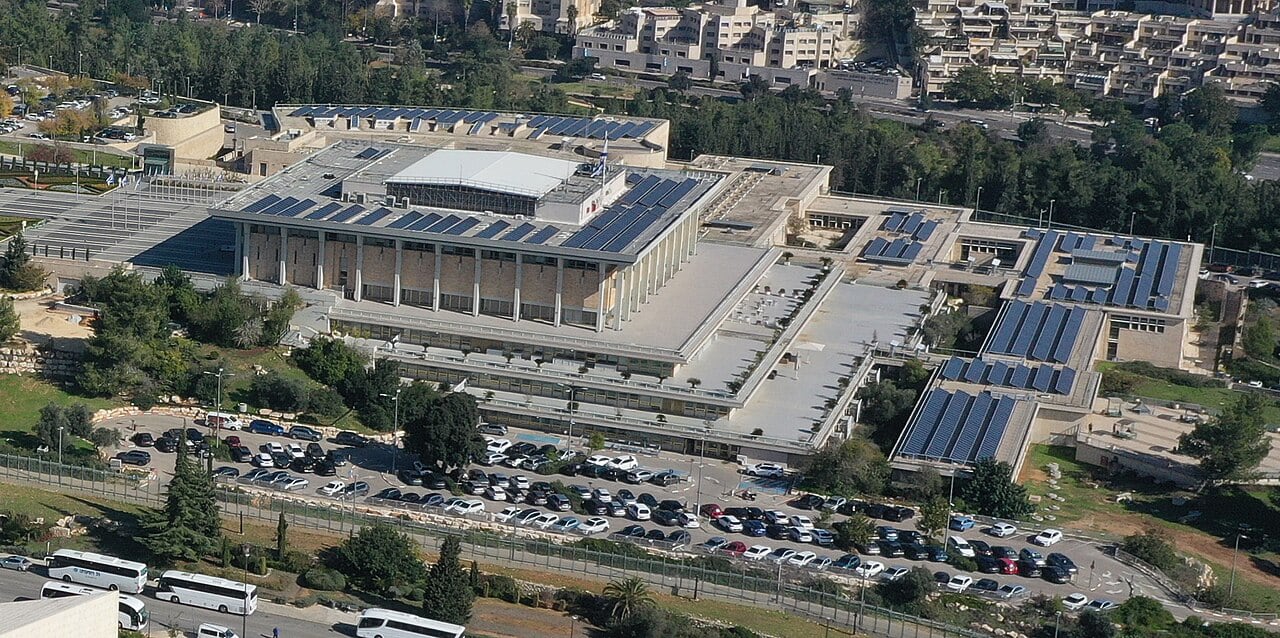
The new Knesset convenes on November 10, when the opposition could attempt to replace its speaker. President Herzog must also decide who gets the first chance to form a government.
Lieberman and United Torah Judaism face important decisions over whom to support, while the Shin Bet investigation could further complicate Eisenkot’s reliance on Arab parties.
Bennett and Lieberman’s conditions leave Eisenkot struggling to form a majority. Netanyahu’s bloc holds 53 seats, short of the 61 needed for an outright majority. Either side could still form a minority government with enough support or abstentions, but this isn’t likely.
If negotiations fail, as now appears more likely than not, Israel will face another election in 2027.
But another war with Iran could change everything. Netanyahu would remain in power as caretaker prime minister, directing the war while his opponents struggle to agree on who should replace him.




Read by the author, not published.